
What if workplace health didn’t depend only on individuals, but also on how work is organized?
Psychosocial risks – stress, tensions, overload, burnout – are now at the core of occupational health and safety issues. They show that well-being at work does not depend solely on individuals, but also on how work is organized and experienced. Understanding the psychosocial work environment therefore makes it possible to take concrete action on working conditions, an approach that is now central to prevention strategies implemented within organizations
Rethinking work
Each year, on April 28, the World Day for Safety and Health at Work invites us to reflect on the conditions in which work is carried out and their impact on health. This day reminds us that workplace safety is not limited to preventing accidents or physical risks: it also includes less visible, yet equally decisive, dimensions for well-being and safety.
In 2026, the International Labour Organization (ILO) highlights a central theme: the psychosocial work environment. A key issue for better understanding how work organization influences well-being, health, and employee engagement. Beyond a symbolic date, this day therefore encourages us to question how work is designed, organized, and experienced on a daily basis.
A major public health and societal issue
According to a recent global report by the ILO, « more than 840,000 people die each year from conditions related to psychosocial risks, such as long working hours, job insecurity, and workplace harassment ». These situations increase the risk of serious illnesses, particularly cardiovascular diseases and mental health disorders.
These figures show that the psychosocial work environment is a major public health issue, as well as a key factor in the proper functioning and performance of organizations.
What do we mean by the psychosocial work environment?
The psychosocial work environment refers to all the conditions in which work is organized, managed, and carried out, as well as the quality of the professional relationships that result from it. It focuses primarily on how the organization functions and on the choices that shape daily work, rather than on individuals themselves.
The ILO report distinguishes three interdependent levels of the psychosocial work environment :
- The nature of work: the demands and responsibilities related to tasks, the match between skills and the work required, access to the necessary resources, as well as the meaning and variety of work.
- Work organization and management: clarity of roles, expectations, workload and work pace, level of autonomy, as well as supervision and managerial support.
- Organizational policies and practices: employment arrangements, working time organization, change management, digital monitoring, evaluation and recognition practices, as well as the prevention of violence and harassment.
Taken separately or in combination, these different levels directly influence how work is experienced and carried out, with effects on health, safety, and well-being at work.
In concrete terms, these factors are present in all organizations, regardless of the sector of activity. They are reflected in workload, deadlines, priority management, hierarchical relationships, and the way work is organized and carried out within teams.
These elements shape how work is experienced on a daily basis. They have an impact on physical and mental health, as well as on safety, by affecting attention, alertness, and the conditions under which work is performed. This is why prevention approaches benefit from being based on real work situations and on teams’ lived experience.
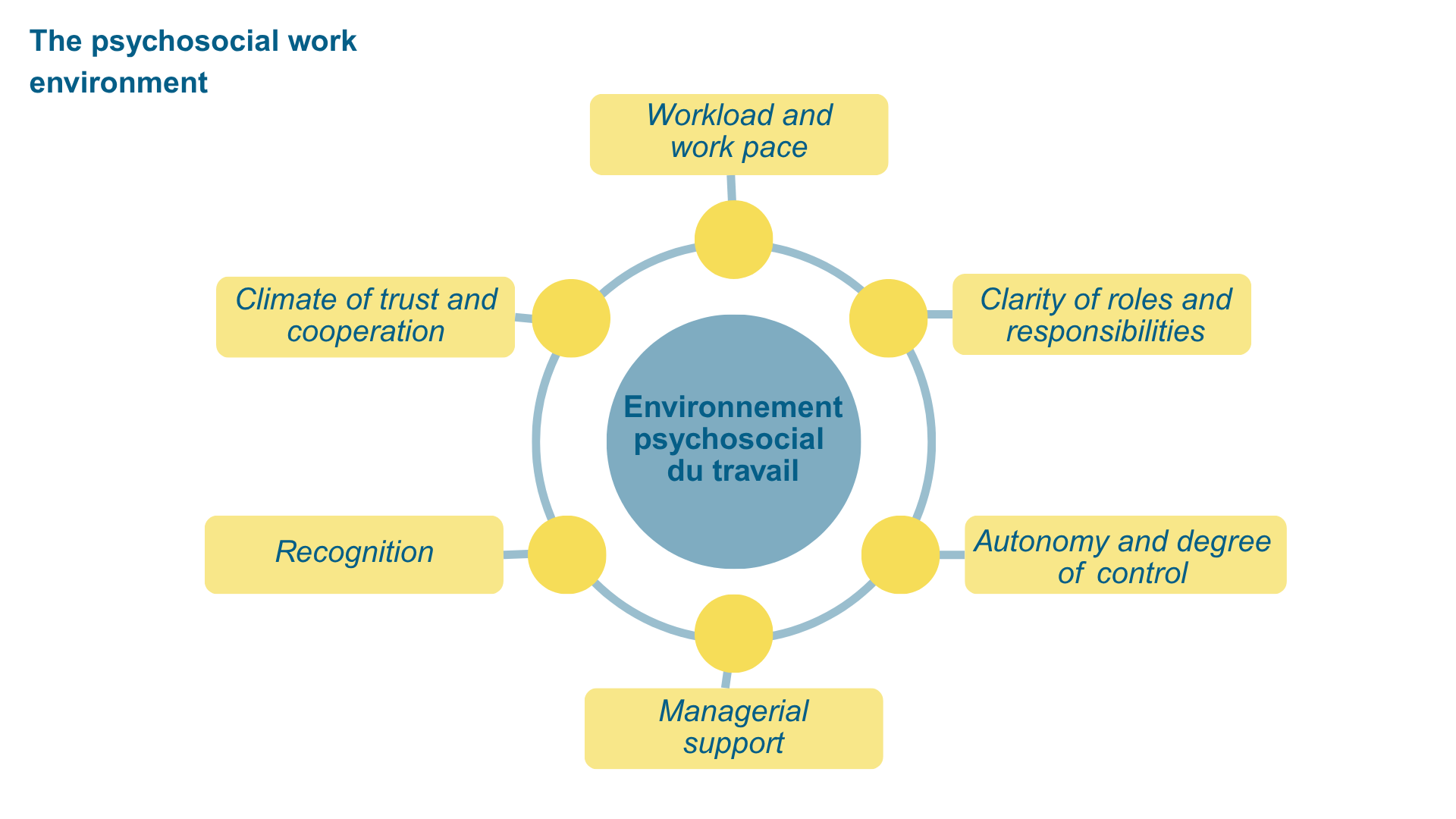
A key factor in health and prevention
When the psychosocial work environment is balanced, it acts as a protective factor. It fosters engagement, motivation, and cooperation, and contributes to sustainable employee health while supporting collective performance.
Conversely, when it is degraded or neglected, it can lead to psychosocial risks such as stress, tensions, or burnout. These situations have both human and organizational consequences: chronic fatigue, reduced well-being, conflicts, disengagement, absenteeism, and difficulties in team functioning.
These issues are primarily linked to how work is organized and the conditions in which it is carried out—aspects on which concrete action can be taken to improve working conditions.
Taking collective action on work organization
Focusing on the psychosocial work environment means changing perspective: it is not about asking people to continuously make more efforts or simply to « hold on », but rather about collectively reflecting on how work is organized and the conditions under which it is carried out.
The prevention of psychosocial risks is based above all on primary prevention actions, which aim to address the organizational causes of the difficulties encountered. This approach involves all stakeholders within the organization and relies on listening, dialogue, and team participation.
Acting on the psychosocial work environment notably involves:
- Discussing the reality of work, in order to better understand what works well and what creates difficulties.
- Clarifying roles, priorities, and expectations, to limit confusion and work overload.
- Providing accessible managerial support, with managers who are available, attentive, and able to take action.
- Ensuring sufficient leeway, allowing teams to cope with unforeseen events and the realities of the field.
Sustained over time, these actions help to build healthier, more balanced, and more human work environments, benefiting people’s health, safety, and engagement, as well as the functioning of organizations — an approach that CHS supports on a daily basis by assisting organizations in their prevention efforts.
« Preventing psychosocial risks means acting on the work itself and on the conditions in which it is carried out. »