
Everything rarely starts with a crisis.
Often, it begins with a temporary overload that slowly becomes permanent. Then other subtle signs appear: a colleague who seems more irritable than usual, repeated absences, a team that gradually loses its energy.
Psychosocial risks often take hold progressively, but their effects quickly become visible: disengagement, tension, burnout, or an increase in resignations.
In Switzerland, nearly one-third of workers report experiencing high levels of stress (SECO, 2022), and nearly half of all absences are believed to be stress-related. These figures remind us that psychosocial risks are not a secondary issue: they directly impact employees’ health and the stability of organizations.
Faced with these challenges, companies can no longer remain passive. Preventing psychosocial risks requires rethinking how work is organized and seeking a sustainable balance between performance and well‑being.
Understanding Psychosocial Risks: Balance at the Heart of Work
Psychosocial risks are not the result of individual weakness. They emerge when the balance between professional demands and the resources available to employees breaks down.
Excessive workload, unclear objectives, lack of autonomy, insufficient recognition, ongoing conflicts… Taken separately, these factors may seem manageable. But when they persist over time, they end up weakening employees’ health and the collective dynamic.
Research in work psychology highlights two major types of imbalance.
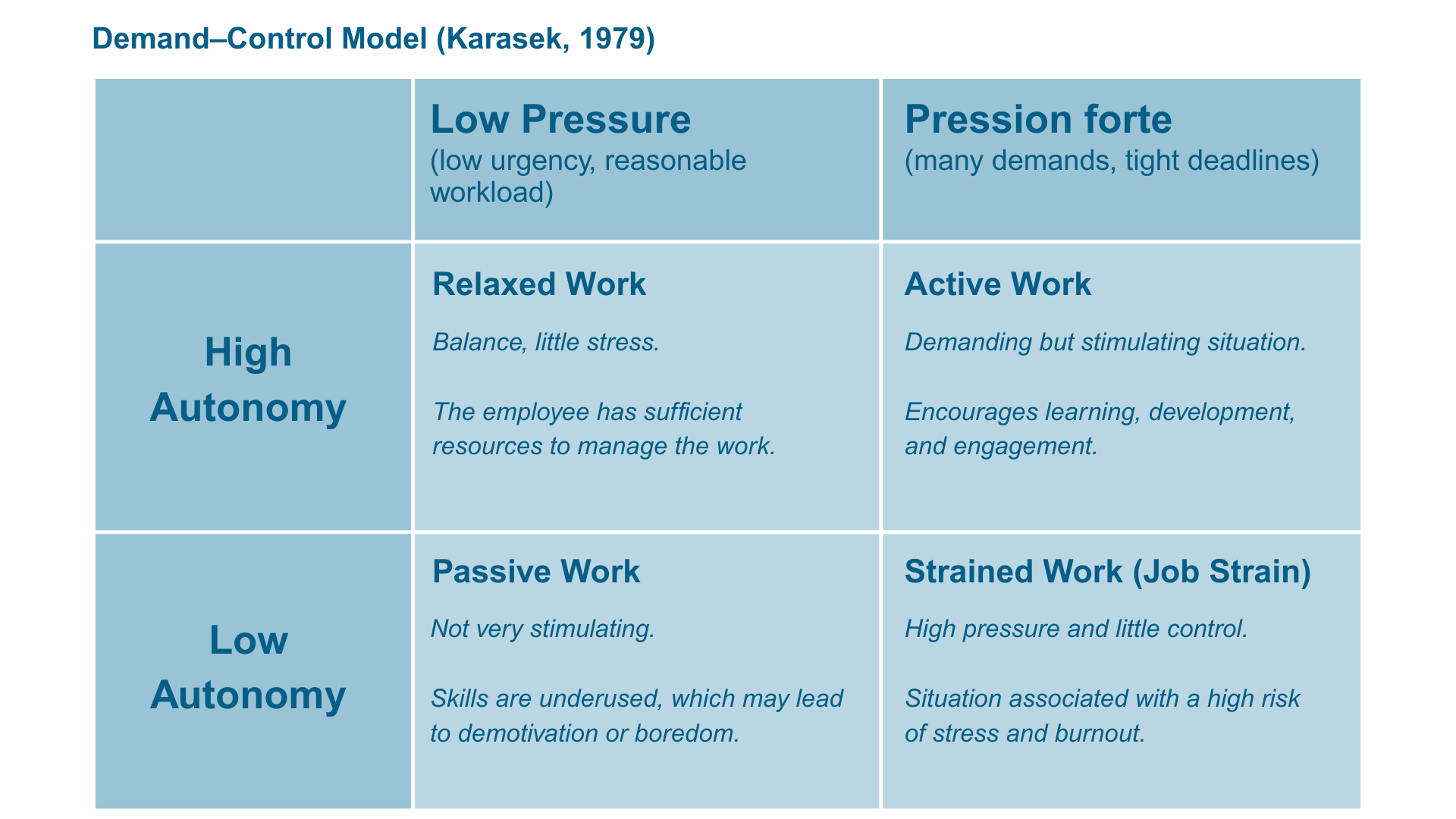
The first relates to the relationship between job demands and the degree of control employees have over their work. When pressure is high, autonomy is low, and support is insufficient, the risk of stress increases significantly. This is illustrated by the demands–control model developed by Robert Karasek (1979). According to this model, it is not only the amount of work that creates strain, but also the lack of control over how that work is organized and carried out.
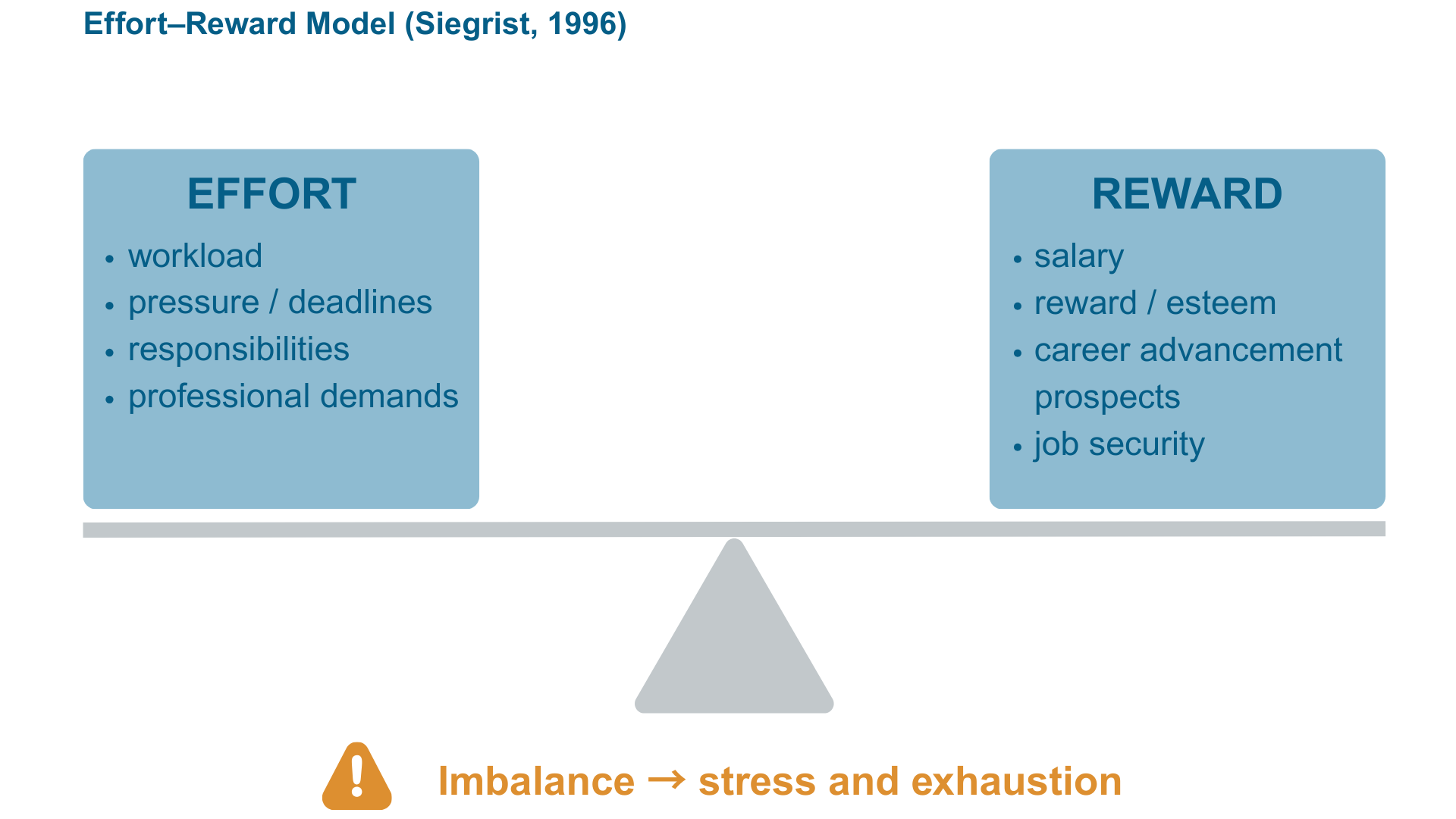
The second imbalance concerns the relationship between the effort invested and the recognition received. According to the effort–reward model developed by Johannes Siegrist (1996), when the effort put into work is not adequately acknowledged — whether through salary, appreciation, or career prospects — a sense of unfairness may arise.
Over time, this imbalance can weaken employees’ engagement and increase the risk of burnout.
Identifying the Signs Before They Take Hold
Psychosocial risks often emerge through subtle changes that are important to recognize early on.
- At the individual level, certain warning signs may appear: persistent fatigue, decreased motivation, heightened irritability, or difficulty concentrating. The employee is still present, but their energy and engagement gradually decline.
- Within teams, tensions may become more frequent. Communication deteriorates or becomes less frequent, and collaboration weakens. The work climate may progressively degrade—without open conflict—but with a noticeable decline in trust.
- At the organizational level, the consequences can also be financial. Turnover represents a significant cost: each departure can amount to roughly 20% of an employee’s annual salary (Gallup, 2021).
Identifying these signals early enough helps prevent situations from worsening. Prevention largely relies on the ability to observe, listen, and take action before difficulties become firmly established.
A Legal Framework That Encourage Action
In Switzerland, preventing psychosocial risks is not only good practice: it is embedded in a clear legal framework.
Article 6 of the Labour Law requires employers to protect the physical and psychological health of workers. This obligation also includes the prevention of harm linked to work organization. Ordinance 3 further specifies that employers must take all necessary measures to ensure and improve health protection.
In practical terms, employers must identify risks, analyze problematic situations, and implement measures to protect employees’ health. While the law does not prescribe a specific method, it expects companies to act proactively.
Beyond legal obligations, this responsibility is also part of leadership’s role and of an organization’s social responsibility.
Acting Sustainably to Prevent Psychosocial Risks
Preventing psychosocial risks is not about intervening only when a situation becomes critical. It requires taking action upstream and integrating prevention into the daily functioning of the organization.
The first step is to establish a clear diagnosis. Relying on data — anonymous questionnaires, qualitative interviews, or organizational analyses — helps identify the true sources of tension and avoid decisions based solely on impressions.
Once the risk factors have been identified, several levers can be activated. Management plays a central role: managers are on the front line to observe team dynamics, adjust workloads, and support employees. Providing them with training and guidance strengthens their ability to detect difficulties and intervene quickly.
Work organization is another key lever. Clarifying responsibilities, aligning resources with expectations, setting realistic priorities, and recognizing efforts all directly contribute to reducing stress factors.
Finally, creating safe listening spaces — such as a Trusted Office Mentor or mediation services — helps address tensions before they become entrenched.
Beyond its human benefits, prevention is also an investment for the company: according to some studies, each franc invested can generate an average return of 2.3 francs in productivity gains (WHO, 2020).
Preventing psychosocial risks therefore means acting on multiple levels and embedding the approach over the long term.
Understanding, Acting, and Progressing
In a constantly evolving work environment, maintaining a healthy balance between demands and available resources has become essential for organizations. A company cannot aim for sustainable performance if its teams operate under constant pressure or in a state of exhaustion.
Preventing psychosocial risks means reflecting on how work is organized and on the priorities set within the company. It also means recognizing that employees’ psychological health plays a key role in team engagement and in the quality of work.
Sustainable performance does not happen by chance.
It is built by preserving balance.
Would you like to learn more about our training courses ?
We remain at your disposal for any further information.
Useful Links
- SECO – Prévention des risques psychosociaux en entreprise : https://www.seco.admin.ch
- INRS – Risques psychosociaux au travail : https://www.inrs.fr
- Agence européenne pour la sécurité et la santé au travail (EU-OSHA) : https://osha.europa.eu/fr
References
- Karasek, R. (1979). Job Demands, Job Decision Latitude, and Mental Strain.
- Siegrist, J. (1996). Effort-Reward Imbalance Model.
- SECO (2022). Baromètre du stress en Suisse.
- OMS (2020). Mental health in the workplace.
- Gallup (2021). State of the Global Workplace.
- Loi sur le travail (LTr), art. 6.