Two employees no longer speak to each other.
A manager feels personally challenged.
Tensions settle in, conversations become cautious… then freeze.
Over time, misunderstandings accumulate, roles become blurred, and emotions take over. What initially started as an occasional disagreement turns into a relational deadlock.
« The conflict is no longer just a disagreement: it becomes a system. »
In these situations, the question is no longer who is right or wrong, but rather: how can we recreate a space where dialogue becomes possible again? This is precisely where workplace mediation comes in.
The Role of the Mediator
The mediator is an independent third party trained in conflict management. The mediator does not judge, arbitrate, or impose solutions. His role is to ensure a safe framework that allows people to communicate differently.
He ensures that agreed rules are respected, that the space remains confidential, and that the quality of the dialogue is maintained.
People often speak about neutrality. In reality, the posture is more subtle: it is about multi-partiality. The mediator seeks to understand each person’s perspective without privileging one version over another.
«It is the parties themselves who find their own solutions. Our role is to create the conditions that make this possible.»
When Conflict Escalates: Understanding Escalation
A conflict never remains static. What begins as a simple disagreement can, over time, become more personal, more rigid, and eventually turn into open confrontation. It may even spread to other team members and affect the entire workplace climate.
Perceptions can also differ greatly: for one person, the situation may feel recent; for another, it may have lasted for a long time. The intensity experienced is not always the same.
To better understand this dynamic, we can refer to the conflict escalation model developed by Austrian psychologist Friedrich Glasl. This model identifies nine levels of escalation, divided into three major phases, ranging from a manageable disagreement to destructive confrontation.
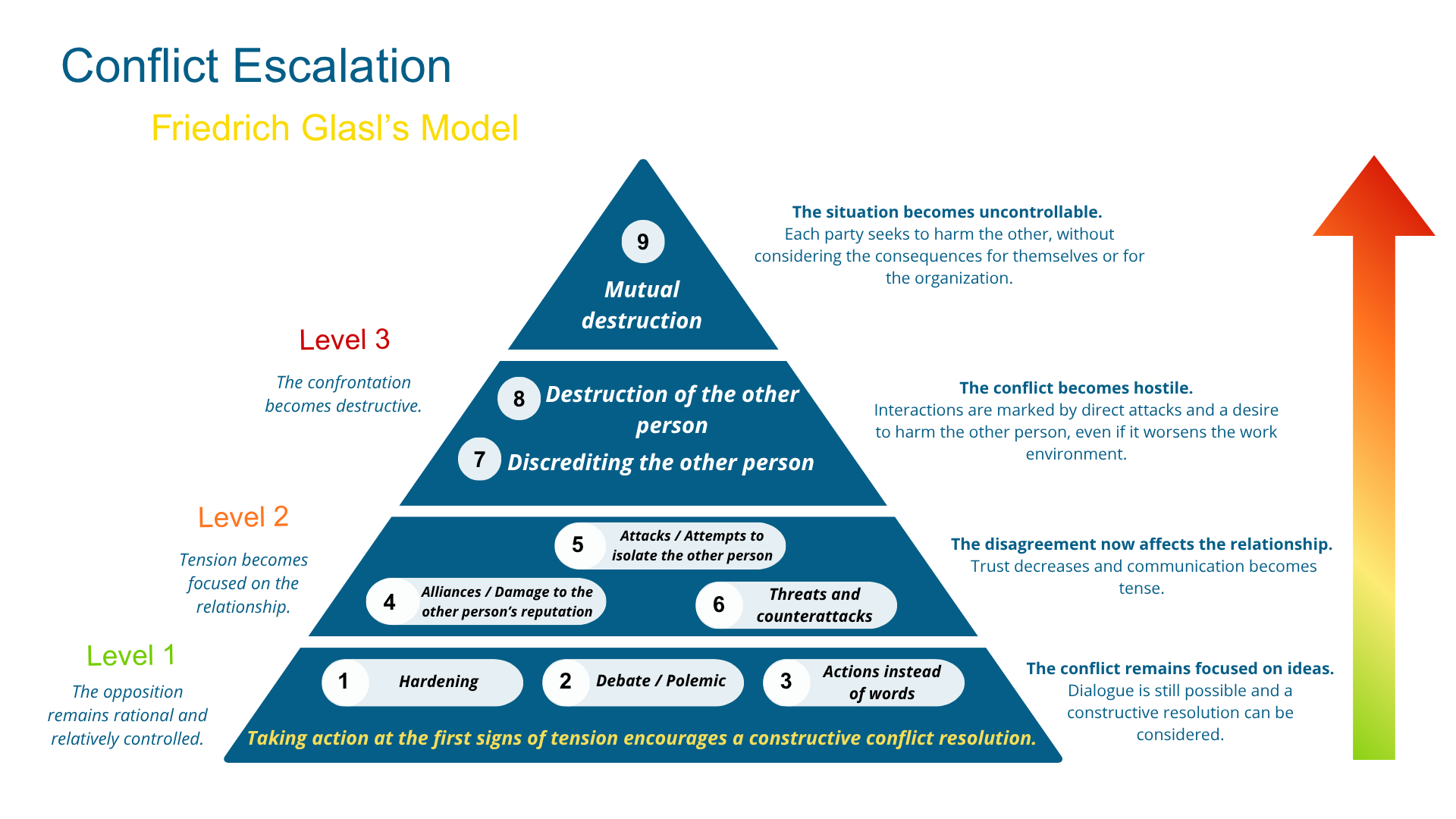
As the conflict progresses along this scale, positions become more entrenched, the relationship deteriorates, and finding a solution becomes increasingly difficult.
Intervening early significantly increases the chances of restoring constructive dialogue. Mediation is particularly relevant during the early stages of escalation, when communication is weakened but still possible.
When Should a Mediator Be Called In?
Timing is crucial.
Mediation becomes relevant when:
- dialogue becomes tense or breaks down;
- misunderstandings are repeated;
- the conflict begins to impact the team or workplace climate;
- a manager feels powerless in dealing with the situation.
It can also be used preventively, as soon as tensions appear or when a collaboration starts to weaken.
Conversely, when the conflict is already deeply entrenched or when the organisational context lacks clarity, other tools may be more appropriate. Recognising the right moment is an integral part of the process.
How does mediation work?
Mediation is not simply about bringing two people together around a table. It is based on a structured, confidential, and voluntary framework.
Setting the Framework and Pausing the Conflict
Before any joint meeting takes place, an assessment is conducted with the organisation to determine whether mediation is the appropriate tool. If the process is confirmed, confidential individual meetings are held to clarify expectations and ensure the parties’ commitment.
A first joint session is then organised within a clear framework based on respect, active listening, and confidentiality, in order to recreate a safe space for dialogue.
Understanding the Situation and Restoring Dialogue
Mediation begins with clarifying the conflict: what happened and how each person perceives the situation. The goal is not to determine who is right, but to understand the situation.
Gradually, discussions become more direct. People begin to genuinely speak and listen to one another. Through reframing and questioning, the mediator fosters better mutual understanding.
Building Solutions for the Future
Once positions have been clarified, concrete adjustments can be defined: clarification of roles, new ways of working together, or shared decisions.
A mediation process generally takes place over three to five sessions of approximately two hours each.
When Mediation Changes the Situation
Mediation does not guarantee that a conflict will disappear. However, it allows the situation to evolve.
Every mediation process is different, depending on the context and the issues involved. Yet one element consistently emerges: the process helps clarify what is truly at stake and unlock relationships that seemed stuck.
A few concrete examples illustrate this:
- A manager convinced that they were responsible for a prolonged absence discovers, through discussions, that their interpretation was incorrect. This realisation eases tensions and allows the relationship to move forward on healthier foundations.
- An employee aspiring to a leadership role realises that their expectations do not match the reality of the position. The collaboration does not continue, but the decision to leave the organisation is made thoughtfully and peacefully.
These situations show that mediation does not always lead to the same outcome. It may help repair a relationship, clarify expectations, or sometimes lead to a constructive separation.
At the organisational level, it also helps clarify unclear roles, restore more direct communication, and prevent the conflict from spreading within the team.
Moving Beyond Deadlock
Mediation does not promise to erase disagreements. It offers a framework that allows the situation to evolve rather than remain frozen. By enabling people to communicate differently, it helps preserve the workplace climate, cooperation, and trust.
Beyond the conflict itself, what is truly at stake is an organisation’s ability to maintain dialogue.
« Mediation is never a failure. It always creates movement. »