
Thoroughness, attention to detail, and commitment: perfectionism is often seen as a valuable quality in the workplace. However, when it becomes excessive, it can contribute to stress, longer working hours, and a higher risk of burnout. How can we distinguish healthy standards from a constant pursuit of perfection? What warning signs should HR professionals and managers watch for? And how can organizations encourage sustainable performance without falling into the trap of “always more”?
Perfectionism: A Strength That Can Backfire
Who doesn’t appreciate working with someone who is conscientious, organized, and detail-oriented?
In many organizations, these qualities are associated with performance and reliability. They inspire trust and often contribute to high-quality results.
Wanting to do a good job is therefore far from being a problem. On the contrary, the desire to improve and deliver quality work is a powerful professional driver.
When the Pursuit of Excellence Becomes a Source of Stress
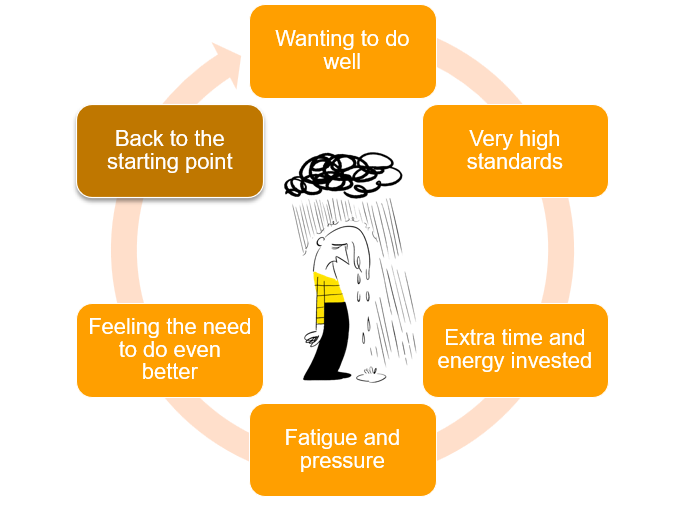
However, for some people, this constant pursuit of excellence eventually takes over. Every task requires more time than necessary, mistakes become difficult to accept, delegating feels risky, and the feeling of never doing enough gradually sets in.
A document is reviewed one last time… and then again.
A presentation that is already finished undergoes multiple revisions.
A minor mistake can be perceived as a major failure.
Over time, the person invests more and more energy to reach a standard that keeps moving further away.
This is the paradox of perfectionism: what often fuels performance can, when taken to extremes, become a source of stress, fatigue, and exhaustion.
The Vicious Cycle of Perfectionism
Signs of Excessive Perfectionism
Taken individually, these signs are not necessarily concerning. However, when they become recurring or accumulate, they may indicate that perfectionism is no longer supporting performance but is beginning to undermine it.
What Employees Say
Some warning signs can be heard in the way a person talks about their work:
- “It’s not good enough yet.”
- “I could still improve it.”
- “I’d rather do it myself.”
- “I can’t afford to make mistakes.”
What Managers and Colleagues Observe
Other signs are more visible through behavior:
- Difficulty delegating
- Repeated reviewing and checking
- Spending significant time on minor details
- Difficulty closing a file or completing a project
- A tendency to redo work that has already been approved
The Impact Over Time
When the situation persists, the consequences become more apparent:
- Longer working days
- Difficulty disconnecting from work
- Ongoing fatigue
- High mental load
- Increased irritability or stress
- Gradual loss of job satisfaction
The Role of Company Culture
Perfectionism is not solely a matter of personality. The work environment also influences how it is expressed, develops, and is maintained over time.
In some organizations, certain behaviors are valued, sometimes implicitly:
- Being available at all times
- Expecting immediate responses
- Viewing mistakes as failures
- Accepting an ever-increasing workload
When repeated over time, these messages can create the impression that employees must constantly do more in order to be recognized or regarded as high performers.
The risk is that overcommitment becomes the norm. Employees invest increasing amounts of energy, gradually push their limits, and pay less attention to recovery, sometimes without even realizing it.
How Can Organizations Prevent the Negative Effects of Perfectionism?
Preventing these risks cannot rely solely on individual responsibility. HR professionals, managers, and leadership teams all play a crucial role in promoting a work culture that is demanding yet realistic and sustainable, where performance is not achieved at the expense of well-being.
- Clarify priorities to help employees focus their efforts on the tasks that create the greatest value.
- Promote the concept of “good enough” when appropriate, rather than systematically encouraging the pursuit of perfection.
- Encourage collaboration rather than individual overperformance by fostering mutual support, shared responsibility, and the freedom to ask for help.
- Train managers to recognize warning signs and start conversations before situations deteriorate.
- Lead by example, particularly by respecting rest periods and setting realistic expectations regarding availability and workload.
Finding the Right Balance
The goal is not to abandon high standards or compromise on quality. On the contrary, the desire to do well, a strong sense of responsibility, and a commitment to continuous improvement are valuable assets for both employees and organizations.
The real challenge is one of balance. Striving for excellence does not mean aiming for perfection at all times.
Sustainable performance relies on the ability to adapt one’s level of effort to actual priorities, accept learning through mistakes, and preserve personal resources over the long term.
True success is not about always doing more. It is about continuing to do good work, sustainably.
Want to Go Further? Discover Our Training on Perfectionism at Work
Perfectionism can be a powerful driver of quality, commitment, and performance. Yet when expectations become unrealistic or inflexible, it can lead to stress, reduced efficiency, and eventually exhaustion.
Our training course helps participants better understand the mechanisms of perfectionism, identify their own thought patterns and behaviours, and develop practical strategies to maintain high standards without compromising their well-being.